How To Get Watchtower Library On Mac
I have an extensive audiobook library (mostly DRM-free) in iTunes, which I actively curate (that is, I break books into chapters, combine chapters into sections, edit the metadata, etc). With Catalina, I understand this content will be moved to the Books app.
If you have played with the Catalina beta, do you know whether I will able to edit audiobooks in Books in the same manner that now is possible in iTunes? If no, any suggestions on non-Apple apps to use for this purpose, not only to edit the content, but then to play it on both Mac and iOS devices?
Thx.
—–
PJ
Note: See How To Manage an Audiobook Collection In macOS Catalina.Bmw scanner 2.1.0 software download.
- To get new add-ins, select Store. To use add-ins you already have, select My Add-ins. The add-ins you'll see will depend on the app you're using and the kind of Microsoft 365 subscription you have. Office for Mac doesn't currently support organization-based add-ins.
- Hold down the ⌥ Option key. This key is in the lower-left corner of the Mac keyboard. Holding it down will prompt the Library folder to appear in the Go drop-down menu.
- Watchtower Library for Mac Video - Duration: 4:01. KeepLifeSimple 14,486 views. 4:01 'The truth about mobile phone and wireless radiation' - Dr Devra Davis - Duration: 1:01:30.
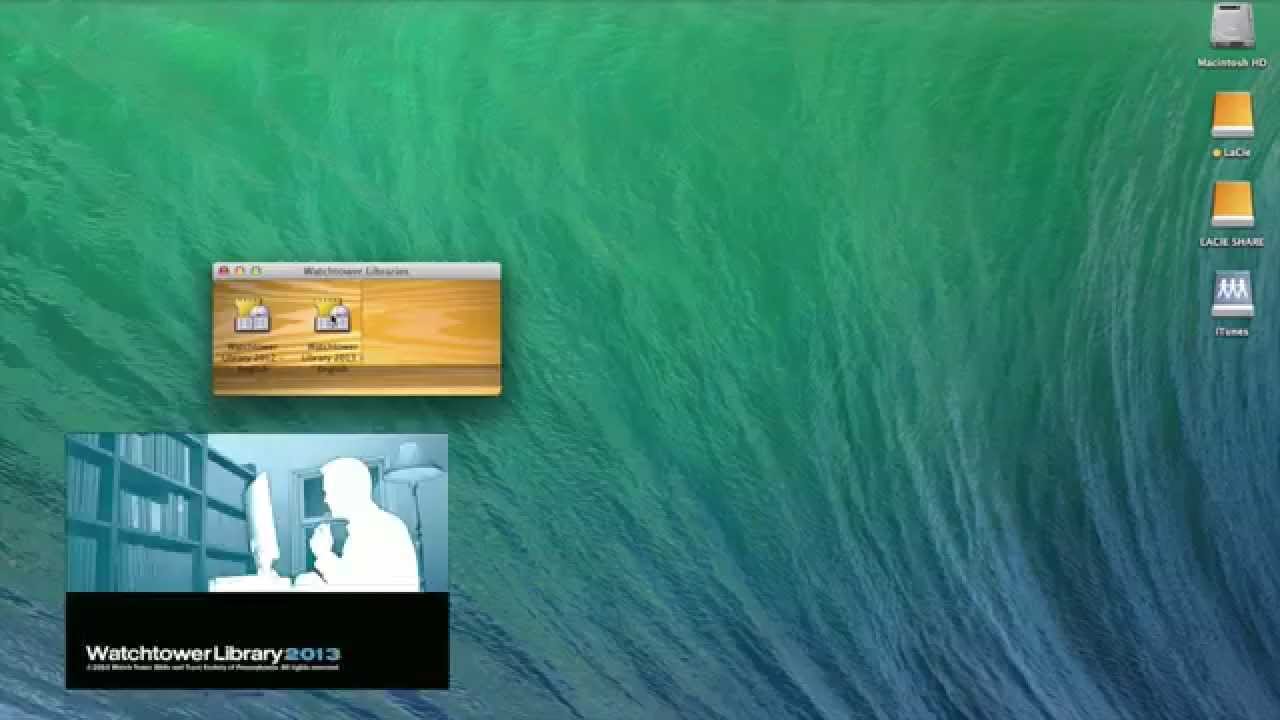
This video is about WTLib Install New Year.
Launch iTunes on your Mac, open its preferences (Edit - Preferences), then click the Advanced tab. Click the Change button next to iTunes Media Folder Location, navigate to the iTunes Media folder. Watchtower Library (CD-ROM, DVD-ROM) Watch Tower Publications Index 1986-2021. Installing kexts is not as simple as removing them. It can be done manually, but using a kext installation utility like KextBeast is much easier. KextBeast was created for use on Hackintoshes, but it will work just as well on a vanilla Mac. Download KextBeast. If you don’t have a free account with tonymacx86.com yet, you’ll need to.
How To Open Watchtower Library On Mac
| #!/bin/bash |
| # Get the path to this script and its containing directory. |
| app_script_path=$0 |
| app_script_dir_path=$(dirname '$app_script_path') |
| # Get the correct username under which the wine files were added. |
| username_path='$app_script_dir_path/username' |
| if [ !-f'$username_path' ];then |
| username=$(whoami) |
| echo'$username'>'$username_path' |
| else |
| username=$(cat '$username_path') |
| fi |
| # Make sure that wtl_paths will be correctly split on newlines instead of spaces. |
| IFS=$'n' |
| # Get the local path to the 'Wine Files' directory and the Windows path to 'WTLibrary.exe'. |
| wine_files_path='/Users/$username/.wine' |
| if [ -a'$wine_files_path' ];then |
| drive_c_path='$wine_files_path/drive_c' |
| wtl_paths=($(find '$drive_c_path/Program Files/Watchtower' -iname WTLibrary.exe 2>/dev/null)) |
| fi |
| if [ !-f'$wtl_paths' ];then |
| wine_files_path='/Users/$username/Wine Files' |
| if [ -a'$wine_files_path' ];then |
| drive_c_path='$wine_files_path/drive_c' |
| wtl_paths=($(find '$drive_c_path/Program Files/Watchtower' -iname WTLibrary.exe 2>/dev/null)) |
| fi |
| fi |
| # Done working with the internal field separator. |
| unset IFS |
| if [ '${#wtl_paths[@]}'-gt'1' ];then |
| forwtl_pathin'${wtl_paths[@]}';do |
| msg='Would you like to open '$wtl_path'?' |
| resp=$(osascript -e 'tell app 'System Events' to display dialog '$msg' buttons {'Yes','No'}') |
| if [[ $resp*:Yes* ]];then |
| break |
| fi |
| unset wtl_path |
| done |
| elif [ '${#wtl_paths[@]}'-eq'1' ];then |
| wtl_path=${wtl_paths[0]} |
| fi |
| if [ -f'$wtl_path' ];then |
| back_slash='' |
| forward_slash='/' |
| c_wtl_path=${wtl_path/$drive_c_path/'C:'} |
| c_wtl_path=${c_wtl_path//$forward_slash/$back_slash} |
| # # Run WTLibrary.exe using Wine. |
| export WINEPREFIX='$wine_files_path/' |
| /Applications/Wine.app/Contents/Resources/bin/wine '$wtl_path' |
| else |
| msg='Unfortunately WTLibrary couldn't be found. Please make sure it is installed using Wine before trying again.' |
| osascript -e 'tell app 'System Events' to display dialog '$msg' buttons {'OK'}' |
| fi |